Hey there! I am Martin.

I grow consumer products through exceptional design.

I build ambitious design teams, lead hands-on and pioneer AI-native workflows.

My favourite wins

    • Role: Head of Product Design & Research
    • Scope: Leadership & Team Transformation
    • Impact: Core CVR −30% → +20%

    Building an AI-powered design team that ships fast and drives growth.

    TL;DR

    TL;DR

    • The design team shipped constantly, but the core product had been declining for a year or two, down around 30% by December.
    • The real problem: they owned the design, not the problem. They worked off briefs and were measured on what shipped, not what changed.
    • I transformed how the team worked, securing the mandate for designers to shape product decisions, establishing continuous discovery and making measurable outcomes our scoreboard. I led through the work itself, alongside the team.
    • Now they deliver results, laser-focused on real user value and measurable impact. They own the problems, decide what to build, and use AI to validate ideas faster and ship alongside their engineering partners.
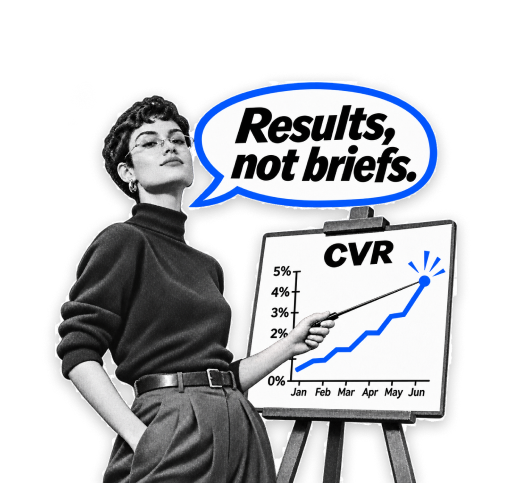
    • Core conversion flipped from a long decline to a 20% growth path, and the team now owns outcomes without waiting to be told.

    Problem

    Shipping hard, and still losing

    The team was busy. Designs shipped, features launched, the backlog kept moving. And the core product kept sliding, it had been trending down for a year or two, and by December it was around 30% off.

    This was never a talent problem. These are strong designers. The problem was the setup they worked in. They owned the design, not the problem. Product decisions were made upstream, leaving designers responsible for the solution but with little influence over the problem itself. Success was measured by what shipped, not by what it changed. So they shipped a lot, and the numbers didn’t move.

    And that creates a trap. When the work doesn’t move the numbers, everyone gets anxious about the lack of results. So you do one of two things, blame execution, or pile on more features hoping something finally lands. More requirements kept coming, the team executed as fast as it could, and it still looked slow, because it was racing to build the wrong things faster.

    Context

    This was the situation

    Spread Group is a global provider of customised apparel and lifestyle products across D2C, B2B and B2B2C. I’m Head of Product Design and Research, leading the design and research team on the core products and its AI tools.

    When I stepped in, the team operated within a traditional, delivery-focused design model. Roughly 90% of their effort went into designing solutions, about 10% into testing, and almost none into shaping what to build. In product that’s the wrong split. The thing that actually moves a business is building the right thing, fast, and the team had little control over the “right thing.”

    Insight

    The team owned the design, not the problem

    Two things became clear.

    First, output isn’t the scoreboard. A shipped feature isn’t a win, a moved number is. Output is what you make. Outcome is what changes because of it. The team was measuring the first and hoping for the second.

    Second, and this was the real one: you can’t move the numbers if you don’t own the problem. Designing beautifully against a problem that doesn’t matter is wasted craft. The team didn’t need to design harder. They needed to be at the start, with users, choosing what to build and owning what happened next.

    And designers are the right people to own that. Their whole craft is understanding people: watching how they actually behave, finding where they struggle, and turning it into something concrete you can put in front of them and test. Give a designer the real problem and they won’t just decorate a solution, they’ll find the one worth building. That instinct was being spent on other people’s briefs.

    Decision

    Go faster, or change the way we work

    When I saw how they worked, there were two ways to go.

    Double down on execution speed

    The easy, popular one. Keep taking briefs and requirements from other teams, and just deliver them faster. Nobody would argue with it.

    Change how we work from the ground up

    The hard one. How we pick what to build, how much time we spend with users, how we measure success, how we talk to stakeholders, design reviews, approval gates, design-by-committee, all of it.

    We chose the hard one. It was painful, and it’s the most exciting work I’ve done.

    In practice that meant three shifts:

    • Designers spend real time in discovery, not just execution.
    • Every initiative aims at a number to move, not a list to ship.
    • The team decides what to build, validated by users, not signed off by a committee.

    It was a bet on the team. Give them the problem, the mandate and the scoreboard, and trust them to run.

    How we work

    Building a team that plays to win

    Changing how we work meant changing how we think. I wanted a team that cares as much about the success of the product as the quality of its design.

    We built our culture around four principles that guide how we make decisions, develop our skills and deliver results.

    Play to win.

    • A confident team member with arms crossed stands beside a whiteboard showing a rising chart with a target and an upward arrow.
      The goal is to win.

      We focus relentlessly on real user value and measurable outcomes. We know our numbers, celebrate our wins, learn from our misses and make every decision count.

    • A smiling designer presses a button on a laptop and three app screens launch out of it.
      Move fast with intent.

      We use AI to explore, prototype and validate ideas faster. We share work early, prefer experiments over opinions and find the fastest way to learn and deliver.

    • A smiling designer holds a large phone mockup while profile, code and growth-chart icons orbit around her.
      Build the product.

      We own problems, not just designs. We proactively shape what to build next, work alongside our engineering partners and stay accountable for the outcome beyond design delivery.

    • A designer lifts a barbell with design-tool icons on its plates while a teammate cheers her on with a stopwatch.
      Train and raise the bar together.

      We continuously train our product judgment and visual craft. We give direct feedback, challenge each other, share what we learn and make exceptional quality a shared responsibility.

    The four principles behind our internal 2026 Play to Win programme.

    How we put it into practice

    Principles mean nothing unless they change what people do every day. Here’s what they look like in practice.

    • We start with a problem and a number to move. Every initiative starts with a real user problem and a measurable outcome. We judge our priorities by the impact they could deliver, not the volume of work we could ship.
    • We stay close to users. Every week, designers watch real people use our products, uncover friction and identify new opportunities. Discovery is part of everyday work, not a separate project phase.
    • We prototype with AI and validate in days. Designers build functional prototypes and test them with users before production development begins. This reduced the time needed to validate an idea by around 10x.
    • We build and ship together. Designers and engineers work side by side from problem to production. Designers contribute directly to code, reducing handoffs and getting improvements into users’ hands in days.
    • We challenge, commit and execute. We debate strategy while it’s forming. Once a decision is made, we align, commit and move fast.
    • We keep score out loud. We measure our impact, celebrate wins, learn from misses and share our results across the company.
    • We train together. We sharpen our product judgment through research and experimentation, and raise our craft through regular critiques, direct feedback and shared learning.

    The result is a team that knows what matters, builds the right things and delivers results fast. They don’t wait for briefs. They go and win.

    What I did

    What I did, and what the team did with it

    My job was to build the conditions. The team’s job was to run in them, and they did.

    • Reset the scoreboard. I made “the goal is a metric, not a deliverable” the rule. The team made it theirs, opening every daily on the number and judging the backlog against it.
    • Won them the mandate. They had little say in what to build, so I pushed discovery to the front and got the approval gates removed. They repaid the trust by talking to 110+ users and testing on the live product every week.
    • Backed the testing habit. I made continuous user testing on the live product the default, not a phase. The team ran 500+ sessions, found 150+ problems, and solved around 80%.
    • Made it fast. I cleared the path to ship: same-day tickets, fixes in days, designers committing straight to code. A size selector that was dragging conversion down was redesigned and out in two to three days.
    • Built trust in evidence. When decisions were challenged, I brought conversations back to the user problem, the evidence and the measurable impact. I backed the team’s judgment while building stakeholder confidence in our new way of working.
    • Made the wins loud. I tied every result to a number and put it everywhere, win-corner, all-hands, company updates. The visibility earned the team credibility, and credibility earned them more room to own.
    • Made the learnings transferable. I turned the team’s successful practices into actionable principles that other product teams could adopt, sharing what worked across discovery, AI-powered experimentation, collaboration and delivery.

    And none of this was from a deck. I stayed hands-on throughout, running user sessions, prototyping with AI, getting into the code and the craft reviews, so the bar I asked for was one I held myself.

    Impact

    The numbers turned around

    We didn’t just turn the product around. We fundamentally changed what the team was capable of.

    Product impact

    core conversion, from a 30% decline to a growth path
    +20%
    core conversion, from a 30% decline to a growth path
    mobile conversion
    +30%
    mobile conversion
    embroidery orders from a reworked tool, a first for the company
    +130%
    embroidery orders from a reworked tool, a first for the company

    Team transformation

    faster validation of product ideas
    10x
    faster validation of product ideas
    shorter time-to-ship
    50%
    shorter time-to-ship
    user testing sessions
    500+
    user testing sessions

    A new AI product reached €1M in net revenue since January, with more than half of it in a single month.

    But the number I’m proudest of isn’t on a dashboard. The team now owns outcomes without being told, breaking down the product and designing its future unasked, debating hard and never taking it personally. That doesn’t come from process. It comes from trust.

    Team

    The team behind it

    This was the team’s win. I built the conditions, the scoreboard, the mandate, the air cover, and I was in the work shoulder to shoulder with them, in the sessions, the prototypes, the code. But the team carried it: the hard calls, the fast fixes, the care.

    Watching talented designers grow into confident product builders who own outcomes is why I love this work. I’m proud of what we achieved together, but even prouder of the team we’ve become.

    Thank you to the designers, researchers and engineers who played to win.

    • Role: Head of Product Design & Research
    • Scope: Craft & Problem-solving
    • Impact: +15% avg. CVR

    How easier mobile editing lifted conversions for millions of Spreadshirt users

    TL;DR

    TL;DR

    • On Spreadshirt, anyone can design custom apparel in a tool called the Designer. Funnel analysis revealed that users were dropping off right after adding a design to their product.
    • Talking to users revealed why: making their designs look right and print-ready was unnecessarily difficult. Removing backgrounds, changing colours and editing text were particularly frustrating on mobile.
    • As Head of Product Design, I led the redesign hands-on, turning complex editing functionality into simple, intuitive interactions.
    • Together with another designer and our engineering partners, we rebuilt the editing experience, validating and refining each improvement through live A/B tests.
    • After several rounds of iteration, conversion increased across all four user groups: those who uploaded their own design +11%, who added text +20%, who used one of our gallery designs +12%, and who used our AI designs +9%.

    Context

    On Spreadshirt, anyone can create custom apparel

    Spreadshirt lets anyone design their own apparel and lifestyle products, t-shirts, hoodies, jerseys, to wear themselves, give as a gift, or represent a company, team or club. The Designer is the tool where they create it.

    Getting a starting image is the easy part now: generate one with Spreadshirt AI, upload one you made with ChatGPT, or pick from thousands of designs made by our community.

    I led the editing experience, everything you do after that to make the design truly yours and print-ready. A close collaboration with another designer on my team, inside a full product team.

    Problem

    Users dropped off right after adding their design

    Digging into the funnel, one pattern stood out. Users were abandoning right after they got a design onto the product, whether they uploaded their own, picked one from the gallery, or added text. Overall conversion kept decreasing with it.

    Insight

    The drop-offs all came down to editing

    We talked to the users who left, and the cause was the same every time: editing. The design was on the product, but making it look right and print-ready was full of friction. Two problems came up again and again.

    Making an image look right on the product was hard.

    It arrived as a raw rectangle, with a background they didn’t want and colours that clashed with the garment, and the tools to fix it were buried. So a design that looked great on its own looked wrong the moment it hit the product. “I uploaded my logo and it came on a white square, and I couldn’t find how to remove it.”

    Adding and editing text was hard, especially on mobile.

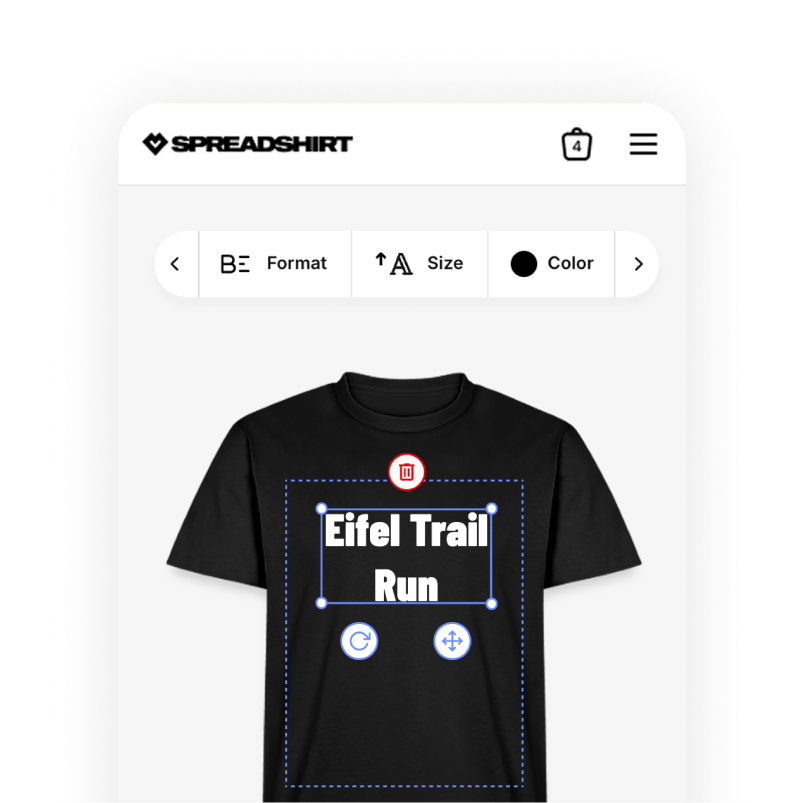
    A name, a date or a slogan is the most common thing people put on a product, and it was the most frustrating. Text spilled outside the print area, fought every edit, and on mobile the keyboard hid what you were typing. “I tried to add my name and it jumped off the shirt, then I couldn’t even see it.”

    Solution

    Make a design look right, in a few taps

    Backgrounds, gone in a tap.

    The thing people couldn’t find is now one clear action.

    Recolour, or rework it with AI.

    Match an image to the product or restyle it in a tap. For a bigger change, regenerate the whole artwork with AI.

    Text that behaves.

    Tap it and you’re typing. It stays inside the print area, no errors, and on mobile the view lifts so you always see what you write.

    One toolbar, built for your thumb.

    The same simple controls for text, images, AI and graphics, all as reach-friendly bottom-sheets.

    Better on desktop, too.

    The same rebuild carried across: a clean side panel instead of bottom-sheets, the same one-tap recolour, background removal and AI, with more room to work.

    Impact

    Editing lifted conversion for every type of user

    Every fix shipped behind an A/B test on the live product. These numbers aren’t a single launch, they’re where we landed after several rounds of testing and iteration. Conversion rose for every kind of user:

    CVR for users who added text
    +20%
    CVR for users who added text
    CVR for users who picked a design from our gallery
    +12%
    CVR for users who picked a design from our gallery
    CVR for users who uploaded their own design
    +11%
    CVR for users who uploaded their own design
    CVR for users who generated a design with AI
    +9%
    CVR for users who generated a design with AI

    Role & team

    I led editing hands-on: design, research, testing

    As Head of Product Design I led this initiative hands-on, in the research, the design, the prototyping and the testing. It was a very close collaboration with Ekran, the other designer on that team, who also led the redesign of other important parts of the experience like product selection, sizing, print techniques and on-canvas behaviour, inside a full product team of a PM and engineers.

    It became one of the biggest revenue drivers around that time, and it came from a team firing on every cylinder, people who all cared about getting it right. None of these numbers happen without them. The win belongs to all of us.

    • Role: Design & Research Lead
    • Scope: Scale & Stakeholder Alignment
    • Impact: +20% seller sign-ups

    How Amazon’s European seller site started winning sellers again

    TL;DR

    TL;DR

    • Amazon's European seller site was losing sellers to other platforms, with sign-ups falling. Amazon hired my team at BBDO to help them fix it.
    • The real cause was that the site was built around Amazon's business structure, not around the seller, which led to fragmented experience and sellers not being able to find important information.
    • Furthermore sellers didn't trust the website because the visual design was outdated and not consistent with the Amazon brand.
    • We chose to build one coherent experience, and I led research, design and aligned the business units behind it.
    • One seller-first experience, new look and built to scale across five markets. It drove sign-ups up 20% and positioned us as trusted partner for Amazon.

    Problem

    Losing sellers and engagement

    Did you know that over 50% of stuff you buy on Amazon comes from third-party sellers? In 2020, this is where potential sellers in Europe had to find information and be inspired to register.

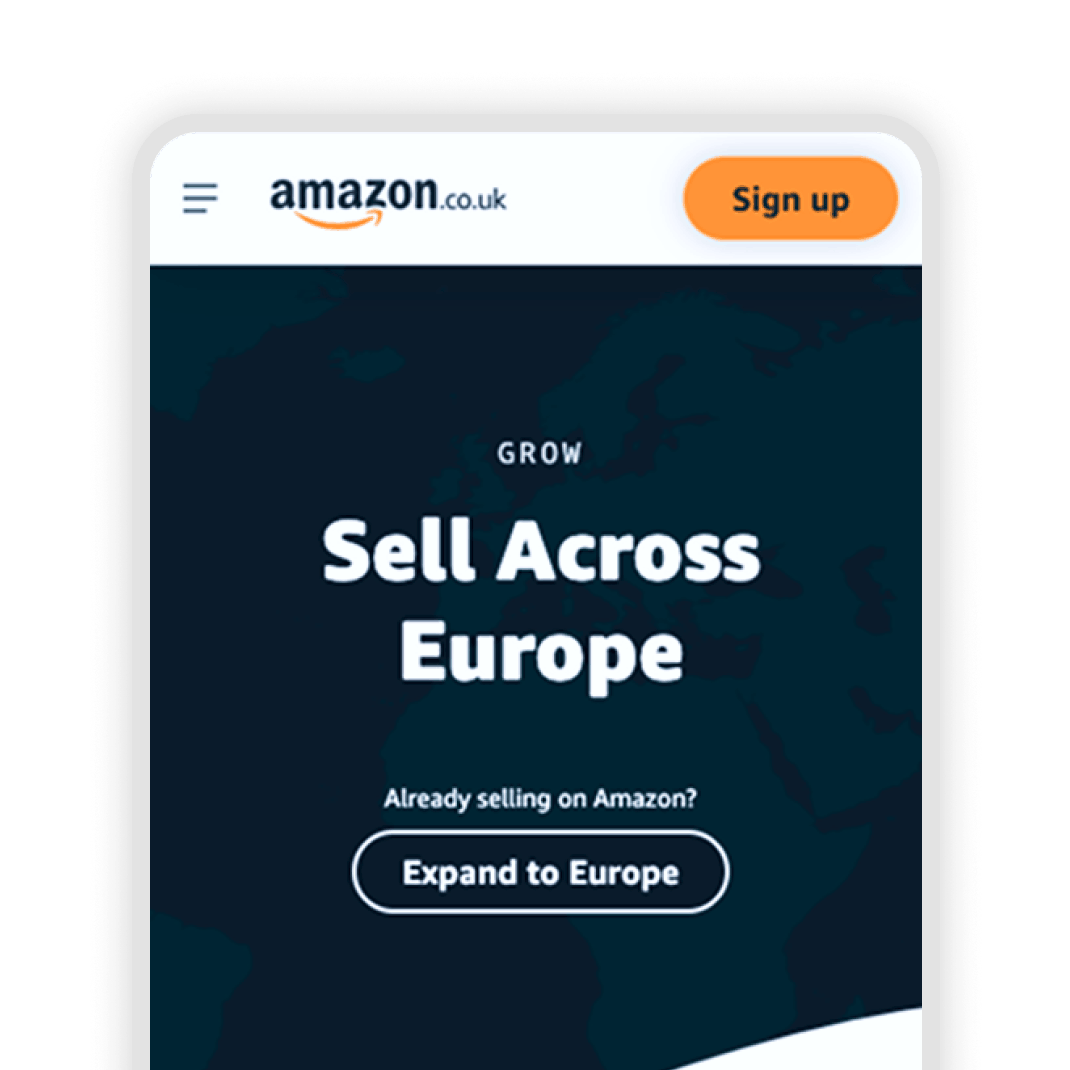
    Amazon's European seller site was outdated and hard to navigate. Potential sellers couldn't find the answers to important questions like local rules, taxes and pricing, and plenty didn't trust it enough to start. So they left, often to sell somewhere else.

    Sign-ups were falling. Bounce rates kept climbing. The biggest marketplace in the world was losing new sellers in Europe.

    Context

    This was the situation

    sell.amazon.de is where a business decides to start selling on Amazon and which services to use, like fulfilment or a special b2b marketplace. In 2021, Amazon brought in BBDO to fix it, and I joined as Lead UX Designer and Researcher.

    It spanned five European markets, each with its own language and its own regulation, and it all had to stay consistent with sell.amazon.com. I worked with a cross-functional team of around a dozen, plus Amazon's regional and North American stakeholders.

    The real constraint was ownership. Every service on the site belonged to a different Amazon business unit, and each one was measured on its own numbers.

    Insight

    The site was built around Amazon, not the seller

    The deeper we looked, the clearer it got: the site was basically Amazon's org chart turned into a website. Three things were really going wrong:

    • Every business unit owned its own page, built its own way. For a seller, that meant a fragmented maze with no clear path in, so they got lost and gave up.
    • The information that mattered most was hidden. Anything no single team owned, like local rules, taxes and pricing, fell through the cracks, so sellers couldn't answer the exact questions that decide whether to commit.
    • It looked like a scam. So dated and out of sync with the Amazon brand that some sellers didn't trust it was really Amazon, and never started.

    Decision

    Optimize the old structure, or rebuild around the seller

    So we had a choice to make. The safe move was to leave the structure alone and optimize each business unit's page harder. Low risk, nobody's toes get stepped on. But that leaves the fragmentation right where it is, and the fragmentation was the whole problem.

    The other option was to tear up the structure and build one experience around the seller. Harder, and political, because some business units would own less of the site than before. We went with the hard one. Optimizing around a broken structure would only lock it in. Some teams gave up ground, and in return the site finally worked for the people it was built for.

    That one call is what turned a redesign into an alignment challenge.

    Approach

    Evidence brought the business units on board

    Choosing the hard path meant the vision had to be undeniable before anyone gave up ground, so we proved it instead of arguing it.

    It started with research. Time with real sellers showed where they got stuck and what actually drove them to commit, and that surfaced the key hypotheses behind the seller-first idea.

    We tested those hypotheses on the live site with experiments and A/B tests. Each result de-risked another piece of the concept before we built it.

    That changed the conversation. Instead of asking the business units to trust a redesign, we showed them it worked, which turned reluctant buy-in into genuine excitement.

    Solution

    One seller-first experience, built to scale

    The site became one seller-first experience. A business arrives, finds the services it needs, gets clear answers on rules and pricing, and signs up, in one coherent flow instead of a maze of disconnected pages.

    A new information architecture

    Organized around seller needs, including the cross-cutting answers no single team had owned.

    A new look, built to scale

    A fresh, distinctly Amazon look that sellers trusted on sight, built as one modular system that flexed across all five markets and their rules without being rebuilt five times.

    None of it shipped without buy-in. Experiments and A/B tests on the key hypotheses gave the vision proof, not opinion, and brought the business units on board.

    Impact

    Sellers came back, and kept coming

    avg. seller sign-ups
    +20%
    avg. seller sign-ups
    avg. bounce rate
    −30%
    avg. bounce rate

    And that 20% came on a site the most data-driven company in the world had already optimized for years.

    For Amazon, this was never only about the numbers. It was about changing the seller experience for good. The work landed well enough that three more European seller business units brought us in for their own UX and design work, and the partnership kept going well beyond this project.

    My role

    Here's what I owned

    As a Lead UX Designer & Researcher, I played a key role in:

    • Defining the final solution. Collaborating with strategists to map sitemaps, content hierarchies, and UX flows.
    • Stakeholder engagement & influence. Presenting research findings to Amazon leadership, driving alignment, and influencing key design decisions.
    • Designing for scale & efficiency. Partnering with project managers to optimize production, implement a modular approach, and ensure timely delivery without sacrificing quality.

    This role required navigating Amazon's complex stakeholder environment, balancing the needs of multiple European markets, and ensuring alignment with the North American team, despite limited direct communication. Beyond design execution, my focus was on influencing key decision-makers, securing stakeholder buy-in, and ensuring that our UX work was not only visually cohesive but also strategically impactful in driving seller conversions.

    Collaboration

    The great team behind it

    This was a real team effort, and I'm proud of what we built together.

    The designers, strategists, data analyst, copywriters and project manager brought their best work, often under real pressure. The account team kept five markets moving at once. And the Amazon teams trusted the vision enough to give up ground for it.

    Huge thanks to the incredible teams at BBDO and Amazon for making this happen! Their dedication, expertise, and collaboration made this project one of the most rewarding experiences of my career.

I have also worked with:

How I Lead

Impact.Passion. Collaboration.

I lead design teams through the moments when products need to evolve, businesses need to grow, and established ways of working need to change. That's the work I love most.

  • Impact

    Design that drives the business

    I connect consumer insights, behavioural data and experimentation to the outcomes the business cares about. I want our products to be experiences people love, return to and recommend. That's how design drives sustainable growth.

    “Martin kept the team focused on solving real customer problems and measuring the impact, so design consistently moved the numbers that are important to us. He did it through strong mentoring and a high bar for the work, and grew a team that delivered results, not just output.”

    SpreadshirtChristian SiehlerVP Product, Spread Group
  • Passion

    Growing good designers into great ones

    I lead through the work itself, giving designers real ownership while contributing directly where it matters most. I develop their craft, product judgment and AI fluency, because exceptional products come from exceptional teams.

    “Martin’s appetite for learning is infectious, and he’s always sharing what he knows with the people around him. He consistently made our projects, and the whole team, better.”

    LogitechViara HristovaDesign Manager, Logitech
  • Collaboration

    Working together is the superpower

    I bring business leadership, Product and Engineering together around a shared experience vision. I challenge functional boundaries and bring AI into how we discover, design and build, so we move faster without compromising craft.

    “Martin makes engineering’s job easier. He gets the constraints before the pixels and keeps design and dev shipping as one team. A genuine pleasure to build with.”

    BBDOIve AndricSr. Developer, BBDO

Experience

14 years in design. 7 leading teams.

From engagement-driven mobile apps to global consumer platforms in fashion, sports and gaming, I've shaped experiences used by millions and built the teams behind them.

  1. 2025 - Present

    Head of Product Design & Research

  2. 2021 - 2025

    Head of Product Design

    BIKE24 (opens in a new tab)

    Cycling e-commerce

  1. 2015 - 2018

    Founding & Lead Designer

    Bet90

    Sports betting & lottery

  2. 2015

    UI/UX Designer

  3. 2013 - 2015

    UI/UX Designer

Curious about how I work?

Here are a few questions I often get.

  • I'm a hands-on design leader who operates at both the strategic and craft levels. I own the experience vision, align leadership around it and build teams capable of turning ambition into measurable outcomes. I lead through the work itself, contributing directly where it matters most, challenging thinking and raising the quality of what we ship. I don't need to design everything, but I take responsibility for the quality of everything we design.

  • I see AI as an opportunity to rethink how we build products, not just do the same things faster. At Spread, designers prototype, validate and ship directly into production with AI, cutting time-to-ship in half and making validation 10x faster. I also build my own AI-native products, designing how models behave, not just the interfaces around them. AI expands what we can build; human judgment and craft determine how good it becomes.

  • I give people real ownership, set ambitious standards and coach through the work itself. I develop their craft, product judgment, strategic thinking and AI fluency, pushing them into meaningful challenges before they feel ready. My commitment to growing talent extends beyond my immediate design team to Product and the wider design community. People I've coached have gone on to senior and leadership roles at companies including Uber, EA and Logitech.

  • I bring consumer insights, business ambitions, emerging technology and design imagination together to envision what a product could become. I make that future tangible through high-fidelity concepts and working prototypes, co-creating it with Product, Engineering and business leadership. A great vision inspires people, aligns decisions and gives teams a shared ambition beyond the next release.

  • I believe we win together. I bring Design, Product and Engineering together around consumer problems, shared ambitions and measurable outcomes, rather than separate deliverables. I challenge functional boundaries and encourage designers to work directly with engineers, build prototypes and contribute to production. We share ownership of the experience, the decisions and the results.

Let's talk

Find me on LinkedIn (opens in a new tab)