From UX designers to product builders who ship fast and deliver results
TL;DR
TL;DR
- The design team shipped constantly, but the core product had been declining for a year or two, down around 30% by December.
- The real problem: they owned the design, not the problem. They worked off briefs and were measured on what shipped, not what changed.
- So I moved designers to the front and worked hands-on alongside them: I set the scoreboard on impact, won them the mandate to choose what to build, and protected their evidence-backed calls.
- Now they deliver results, laser-focused on real user value instead of stakeholder requests. They own the problems, decide what to build, and AI runs the research ops behind them.
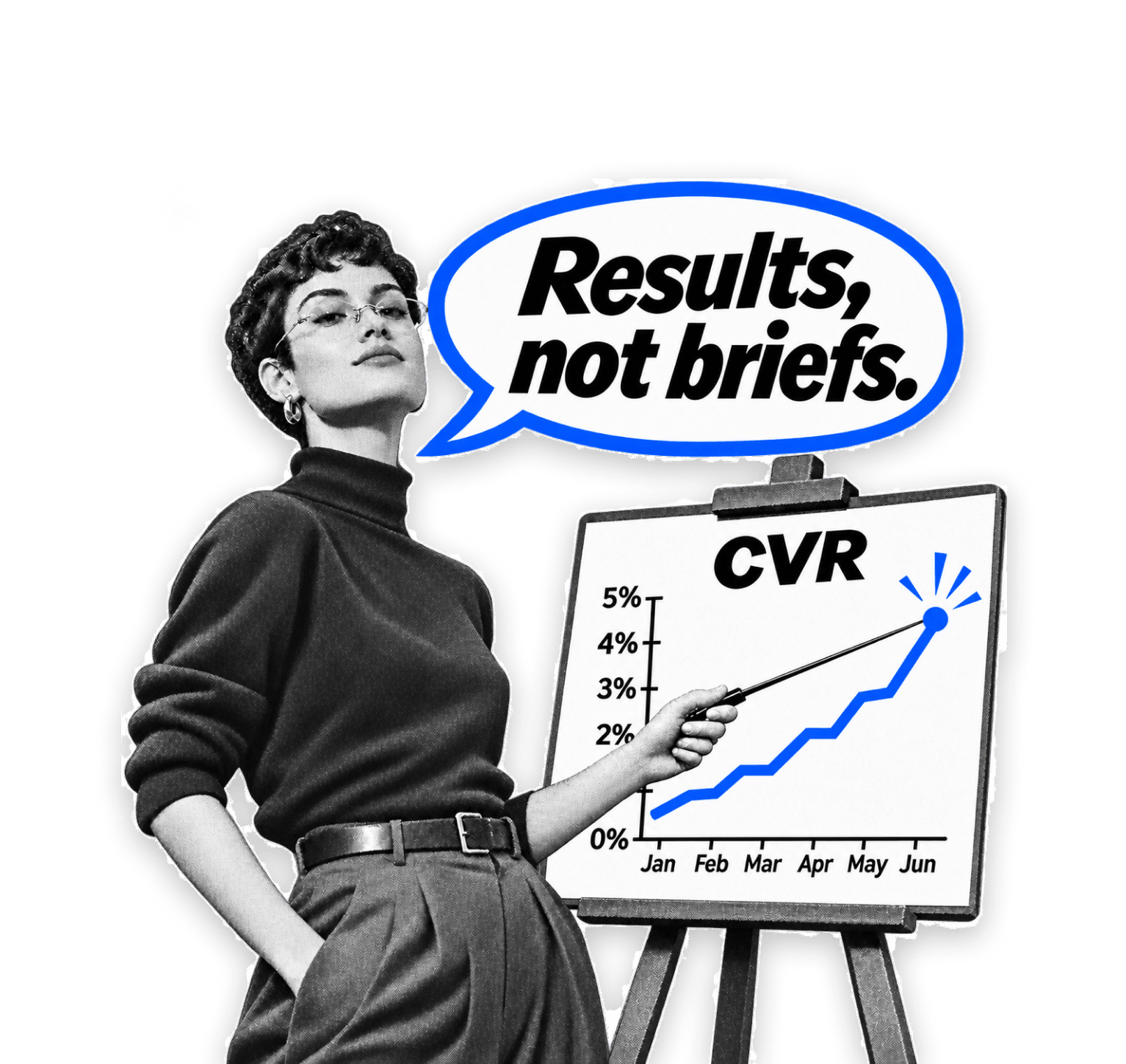
- Core conversion flipped from a long decline to a 20% growth path, and the team now owns outcomes without waiting to be told.
Problem
Shipping hard, and still losing
The team was busy. Designs shipped, features launched, the backlog kept moving. And the core product kept sliding, it had been trending down for a year or two, and by December it was around 30% off.
This was never a talent problem. These are strong designers. The problem was the setup they worked in. They owned the design, not the problem: someone else decided what to build, and they made it look good. Success was measured by what shipped, not by what it changed. So they shipped a lot, and the numbers didn’t move.
And that creates a trap. When the work doesn’t move the numbers, everyone gets anxious about the lack of results. So you do one of two things, blame execution, or pile on more features hoping something finally lands. More requirements kept coming, the team executed as fast as it could, and it still looked slow, because it was racing to build the wrong things faster.
Context
This was the situation
Spread Group is a global provider of customised apparel and lifestyle products across D2C, B2B and B2B2C. I’m Head of Product Design and Research, leading the design and research team on the core products and its AI tools.
When I stepped in, the team worked like classic UX designers: roughly 90% of their effort went into designing solutions, about 10% into testing, and almost none into deciding what to build. In product that’s the wrong split. The thing that actually moves a business is building the right thing, fast, and the team had little control over the “right thing.”
Insight
The team owned the design, not the problem
Two things became clear.
First, output isn’t the scoreboard. A shipped feature isn’t a win, a moved number is. Output is what you make. Outcome is what changes because of it. The team was measuring the first and hoping for the second.
Second, and this was the real one: you can’t move the numbers if you don’t own the problem. Designing beautifully against a problem that doesn’t matter is wasted craft. The team didn’t need to design harder. They needed to be at the start, with users, choosing what to build and owning what happened next.
And designers are the right people to own that. Their whole craft is understanding people: watching how they actually behave, finding where they struggle, and turning it into something concrete you can put in front of them and test. Give a designer the real problem and they won’t just decorate a solution, they’ll find the one worth building. That instinct was being spent on other people’s briefs.
Decision
Go faster, or change the way we work
When I saw how they worked, there were two ways to go.
Double down on execution speed
The easy, popular one. Keep taking briefs and requirements from other teams, and just deliver them faster. Nobody would argue with it.
Change how we work from the ground up
The hard one. How we pick what to build, how much time we spend with users, how we measure success, how we talk to stakeholders, design reviews, approval gates, design-by-committee, all of it.
We chose the hard one. It was painful, and it’s the most exciting work I’ve done.
In practice that meant three shifts:
- Designers spend real time in discovery, not just execution.
- Every initiative aims at a number to move, not a list to ship.
- The team decides what to build, validated by users, not signed off by a committee.
It was a bet on the team. Give them the problem, the mandate and the scoreboard, and trust them to run.
How we work
Make them product builders good at design, not ‘just’ UX designers
This is how the team works now. Not a framework on a wiki, a way of operating you can feel the moment you sit with them.
- The problem comes first, the result is what matters. Every initiative starts with a user problem and a number to move. If a piece of work won’t move the number, it waits. Impact is the only scoreboard we keep.
- We live with users, and AI runs the logistics. The team is in front of real users every week. An AI research-ops workflow handles the recruiting, scheduling and setup, so designers spend their time watching people use the product, not organising sessions.
- We prototype with AI and validate in days. Designers build working prototypes with AI and test them with users before any production code exists. It cut the time to validate an idea by around 10x. Ideas get proven or killed in days, not sprints.
- We ship, we don’t hand off. Designers push real polish straight to production. The old bug loop, find it, document it, explain it, ticket it, wait, became three steps: find it, fix it, commit it.
- We commit, then we execute. We challenge strategy while it’s forming. Once it’s set, we align and commit, whether or not we agree. Then we move.
- We keep score out loud. Every win is tied to a number and shared across the company. Momentum compounds, and so does the team’s influence.
- We build each other up. Feedback is fast, direct, and never personal. Designer and engineer run in parallel, each to their superpower, and that collaboration is the edge.
This is a team that runs its own research, prototypes with AI, ships its own code, and measures itself by what changes for users and the business. They don’t wait for briefs. They go and win.
What I did
What I did, and what the team did with it
My job was to build the conditions. The team’s job was to run in them, and they did.
- Reset the scoreboard. I made “the goal is a metric, not a deliverable” the rule. The team made it theirs, opening every daily on the number and judging the backlog against it.
- Won them the mandate. They had little say in what to build, so I pushed discovery to the front and got the approval gates removed. They repaid the trust by talking to 110+ users and testing on the live product every week.
- Backed the testing habit. I made continuous user testing on the live product the default, not a phase. The team ran 500+ sessions, found 150+ problems, and solved around 80%.
- Made it fast. I cleared the path to ship: same-day tickets, fixes in days, designers committing straight to code. A size selector that was dragging conversion down was redesigned and out in two to three days.
- Protected the calls. When stakeholders pushed to revert evidence-backed decisions, I held the line with the user problem and the metric that moved, so the team could keep playing to the number instead of to opinions.
- Made the wins loud. I tied every result to a number and put it everywhere, win-corner, all-hands, company updates. The visibility earned the team credibility, and credibility earned them more room to own.
And none of this was from a deck. I stayed hands-on throughout, running user sessions, prototyping with AI, getting into the code and the craft reviews, so the bar I asked for was one I held myself.
Impact
The numbers turned around
The team moved the product.
- core conversion, from a 30% decline to a growth path
- +20%
- core conversion, from a 30% decline to a growth path
- mobile conversion
- +30%
- mobile conversion
- embroidery orders from a reworked tool, a first for the company
- +130%
- embroidery orders from a reworked tool, a first for the company
A new AI product reached €1M in net revenue since January, with more than half of it in a single month.
But the number I’m proudest of isn’t on a dashboard. The team now owns outcomes without being told, breaking down the product and designing its future unasked, debating hard and never taking it personally. That doesn’t come from process. It comes from trust.
Team
The team behind it
This was the team’s win. I built the conditions, the scoreboard, the mandate, the air cover, and I was in the work shoulder to shoulder with them, in the sessions, the prototypes, the code. But the team carried it: the hard calls, the fast fixes, the care.
Watching strong designers grow into product builders who own the outcome is why I do this work. The win is theirs. I built the room, and I worked inside it.
Thank you to the designers, researchers and engineers who played to win.